
Changing and editing annotations
If an asset’s status changes to “To review”, labelers are no longer allowed to make any changes to the labels in that asset: when they try to do it, a warning message is displayed and the changes are not saved. This eliminates possible quality issues.
Selecting annotations
- Single Annotation Selection: Simply click on an existing annotation to select it.
- Bulk Annotation Selection: Hold down the
CmdorCtrlkey while clicking on each annotation you want to select.
Changing class
To change the class of one or more annotations:
- Right-click the annotation or group of annotations,
- Select
Change class, - Select the new class (or classes) for the object.
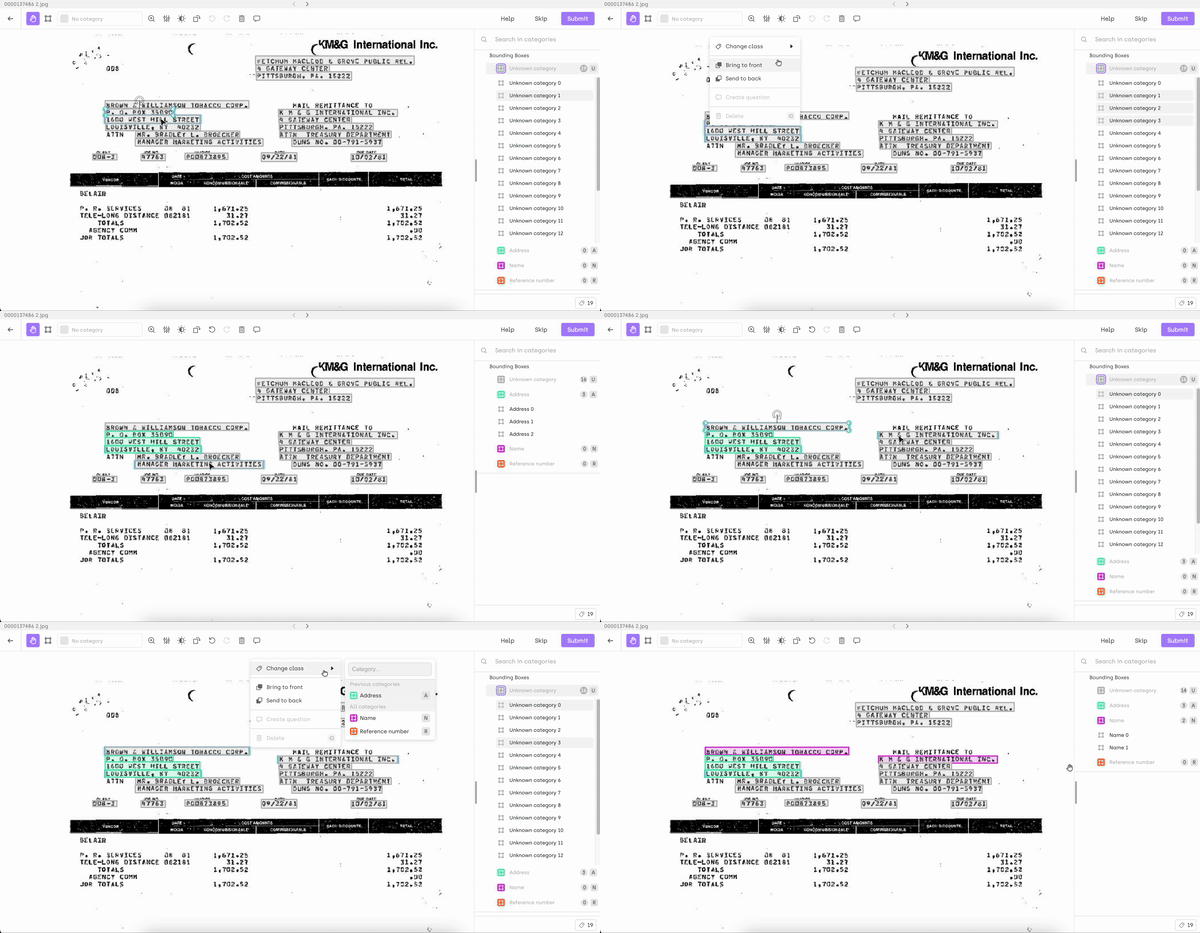
- You can also use the search bar and type the name of the class you're looking for.* You can also directly use the shift + the class shortcut key to change the class of the select annotation.
To edit the shape of graphical elements (line, polygon, bounding box) after you placed them on an asset, click on the element and use the controls that appear on screen.

If the controls don't show up, select the correct tool on the right side of the screen and retry.
Filling nested jobs
When a class has nested jobs, you fill them from the nested jobs menu. Picking a class when you create an object doesn't open the menu, so you can complete nested jobs when it suits you.
To open the menu, select the object, then either:
- right-click it and select Edit nested jobs;
- click the values in its tag.
The menu lists the nested jobs of the object's class. Jobs already filled show their value as a full path. Empty jobs show their first-level values and whether they're required.
Searching for a value
Type in the search field to find a value at any level of any nested job. Search ignores accents and case. You can add part of a parent's name to narrow the results: for example, mil pick only returns the Pick-up under Military.
Each result shows its full path. When several values share a name, the part of the path where they differ is highlighted.
When you select a value, all its parent levels in that job are filled automatically. Other jobs are never changed.
Browsing and stopping at an intermediate level
Values with children show how many they have. Click the chevron, or press →, to open a value. Use the breadcrumb, or press ←, to go back up.
You can select any level, not only the last one. Inside an opened value, click Select «value» to stop at that level. If the next level is a required job, it stays incomplete until you fill it.
Nested transcription jobs appear as text fields in the menu. They aren't included in search.
Using the keyboard
| Key | Action |
|---|---|
| ↑ / ↓ | Move |
| Enter | Select |
| → | Open a value |
| ← | Go back up |
| Esc | Close the menu |
After each selection, the highlight moves to the next empty job, required jobs first.
Reading values in the tag
The object's tag shows the value of each nested classification job. Hover over it to see each value's full path, including values cut off by the tag's length.
- In Video projects, a value set from the menu applies from the current frame to the next keyframe. Tag values can't be clicked while the video is playing.
- When the asset is read-only for you, the tag can't be clicked, and Change class and Edit nested jobs are disabled.
Updated 10 days ago